

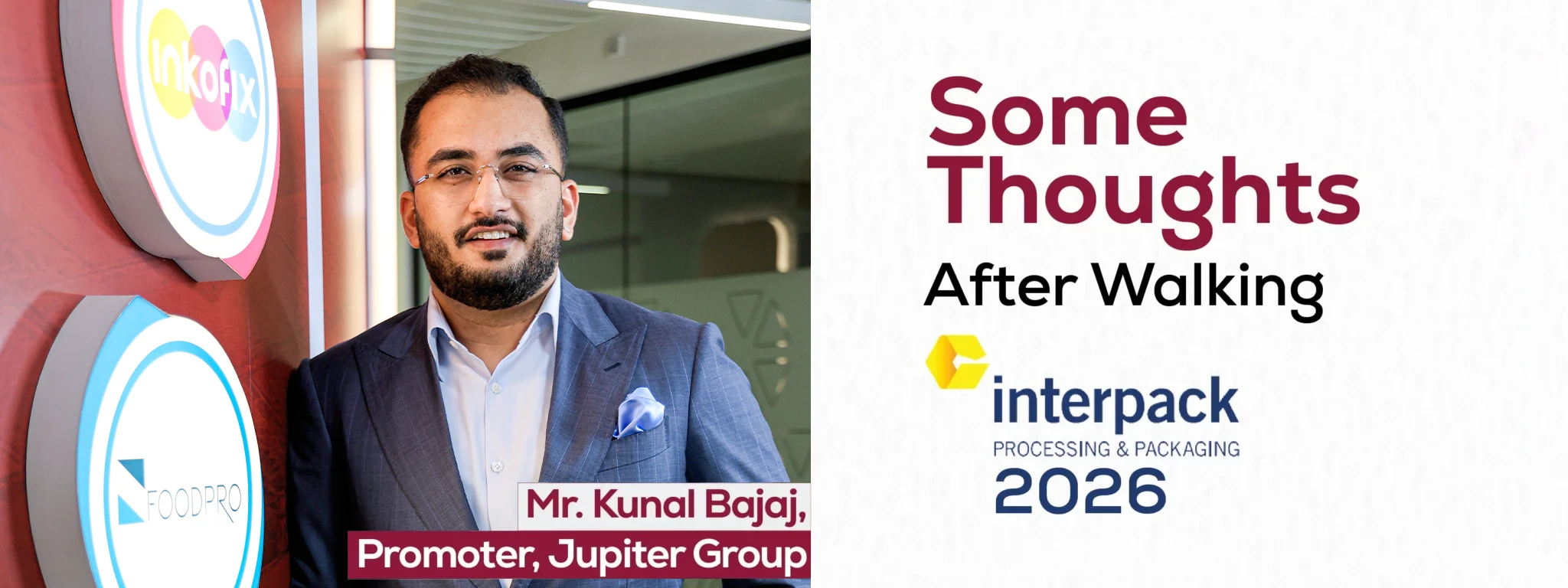
Interpack 2026 the world’s largest packaging trade fair concluded recently, and I was fortunate to attend with our leadership team. Over several days in Düsseldorf, we walked the halls, sat in on conversations, and observed an industry that is no longer preparing for the future – it is actively building it. I wanted to share a few reflections not as a company announcement, but as someone who has spent his working life in flexible packaging and returned with a clearer understanding of where this industry is headed, and what it is now demanding from all of us.
THE SCALE OF IT FIRST
2,804 exhibitors from 65 countries. Visitors from 161 nations. The largest edition of Interpack in the trade fair’s history. Numbers like that matter not because they are impressive, but because they tell you something about the seriousness of the moment. When this many people gather around one subject, the subject is no longer optional.
WHAT THE WORLD’S BIGGEST BRANDS ARE NOWDEMANDING
The single clearest signal from Interpack 2026 was this: sustainability has moved from a brand story to a business requirement, with real financial and operational consequences. This is not about corporate messaging anymore. Brands are making structural decisions about their packaging partners, their material choices, their supply chain based on measurable, verifiable sustainability outcomes.
The most progressive companies at Interpack 2026 weren’t just telling you they had a sustainable product. They were telling you how how many kilograms of carbon saved per unit, what percentage recyclable, how compliant with legislation. That specificity is the new standard.
The conversation has shifted from experimental sustainability to operational compliance. There is a clear move away from complex multi-layer plastics toward designs optimised for existing mechanical recycling streams. Non-recyclable laminates are not being phased out slowly. They are being replaced with intent.
THE MATERIALS REWRITING THE INDUSTRY
Fibre-based materials, bio-based solutions, mono-material structures these are no longer in research and development. They are market-ready, being used across food, beverage, cosmetics, and pharmaceutical sectors. Alternative raw materials derived from algae, fungal mycelium, and cellulose waste are entering the mainstream conversation. Intelligent coatings that carry temperature indicators, anti-counterfeiting properties, and barrier functions are redefining what packaging can do beyond containment.
Smart Packaging, Circular Economy, Intelligent Systems and AI, Innovative Materials these were the four defining themes across the week. And together they represent a direction, not a trend. Directions don’t reverse.
WHAT THIS MEANS FOR INDIA – AND FOR US
India is at a genuine inflection point in packaging. Our FMCG sector is growing, our brand landscape is maturing, and our consumers are beginning to ask the same questions that European consumers asked five years ago. The regulatory environment will follow. It always does.
The brands we serve – in food, personal care, pharmaceuticals, and household products – will increasingly ask their packaging partners a single, non negotiable question: Can you protect my product, represent my brand, and demonstrate responsibility toward the environment?
At Jupiter Group, our answer to this is built into our structure. From lamination capabilities at Jupiter Laminators, to specialised ink solutions at Inkofix, to precision cylinder engraving at Engrave+, we are not a single-service vendor responding to briefs. We are an integrated flexible packaging ecosystem, connected across the value chain. That integration is not a convenience. In the new era of packaging, it is a necessity. Because the solutions that brands will need combining material innovation, colour precision, structural integrity, and sustainability compliance cannot come from disconnected suppliers working in silos. They require a system. We are building ours.
A CLOSING THOUGHT
I left Interpack 2026 not overwhelmed, but energised. Because everything I saw confirmed something I have believed for a long time that flexible packaging done with genuine craft, technical rigour, and forward thinking is one of the most consequential industries in the world. It touches every product on every shelf in every home. The industry is raising its own bar. That, to me, is the most encouraging thing of all. If any of this resonates – or if you see it differently – I would genuinely enjoy hearing your perspective in the comments.